

There is a moment most engineering leaders recognise. The team has more work than it can handle, a deadline is getting closer, and someone suggests opening a new headcount request. The logic seems obvious. More people, more capacity. But anyone who has been through a few hiring cycles knows that opening a role and actually having a productive person in the team are two very different things.
That gap, between the decision to hire and the point where someone is genuinely contributing, is where a lot of delivery pressure builds up. Team extension is one way to handle it. Not always the right way, but in certain situations, a more practical one.
When the timeline does not match the hiring process
A typical hiring process for a senior developer takes somewhere between six weeks and four months, depending on the role, the market, and how much internal time you can put into it. Screening, interviews, offers, notice periods, onboarding. By the time someone is writing production code, the original problem has often already cost you.
If you have a delivery window that matters, whether it is a product launch, a client commitment, or a sprint cycle that needs reinforcement now, hiring for it is usually not the answer. The process moves too slowly to match the actual need.
Team extension, when it is set up properly, can get a senior developer into your workflow in a matter of weeks. Not because the process is shortcuts, but because the sourcing, vetting, and contracting work has already been done.
When the need is real but not necessarily permanent
Some capacity problems are structural. The team is consistently under-resourced and the work is only going to grow. In those cases, hiring makes sense and team extension is just a bridge.
But a lot of capacity problems are not like that. They are tied to a specific phase: a platform migration, a product area that needs a push, a period where two or three things landed at the same time. The need is genuine, but it is not necessarily a reason to add a permanent role.
A permanent hire comes with a long tail of obligations. Salary expectations, benefits, management overhead, and eventually the awkward conversation if the workload drops. Team extension keeps the arrangement proportional to the actual need. You bring in the right person for the right period, and you adjust when the situation changes.
When integration matters more than headcount
There is a version of outsourcing that nobody likes: a remote team working in parallel, loosely connected to the main delivery process, producing output that someone else has to review and integrate. That model creates overhead rather than reducing it.
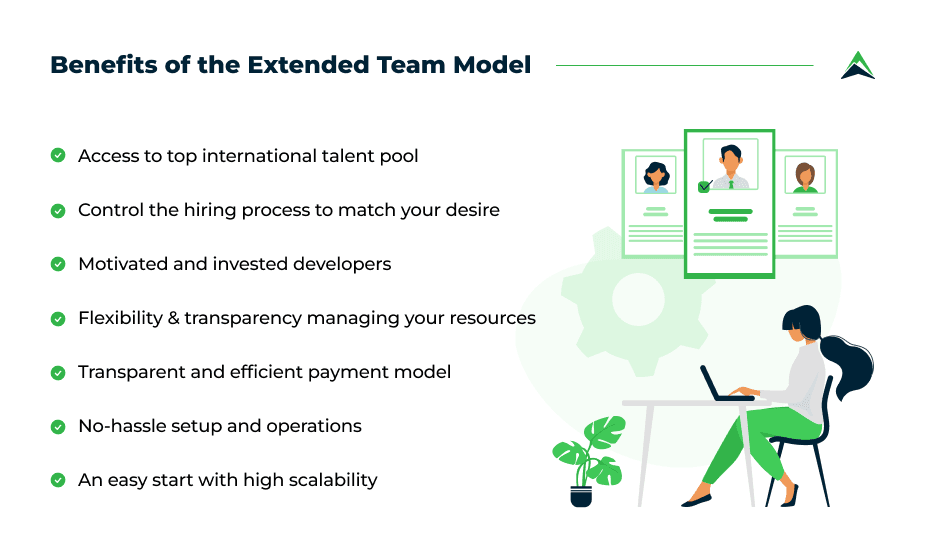
Good team extension works differently. The developer joins your Jira, attends your standups, communicates through your Slack channels, and works inside your sprint cycles. They are not a separate track. They are part of the team for the time they are engaged.
This matters because the alternative, adding people in a way that creates coordination friction, often costs more than it saves. A senior developer who integrates well and requires minimal management will contribute more than two junior contractors who need constant direction.
The quality of the integration is what determines whether team extension actually helps or just adds noise.
What this looks like when it works well
When team extension is handled properly, the person coming in already has experience working inside other companies’ processes. They are not learning how to collaborate across time zones or how to ask good questions in a code review. They have done it before.
The onboarding is shorter not because it is skipped, but because the developer knows what to look for and how to get up to speed without pulling the rest of the team into lengthy handover sessions. Within a week or two, they are contributing. Within a month, they are usually indistinguishable from an internal team member in terms of how they work.
That is the bar worth holding to. Not just someone who can write the code, but someone who fits into the way the team actually works.
The point is not to avoid hiring
Hiring is the right answer when the need is long-term, when you want someone to grow with the product, and when the role requires deep institutional knowledge over time. There is no argument against building a strong internal team.
The argument is simply that not every capacity problem calls for the same solution. When speed matters, when the need is tied to a specific phase, and when you want someone who works as part of your team rather than alongside it, team extension is often the more practical choice.